

.png)
Commercial cleaning robots have moved beyond pilot projects. Today, they clean retail stores, offices, schools, healthcare facilities, warehouses, transportation hubs, and manufacturing plants while employees focus on higher-value work.
The opportunity is significant, but successful deployment requires more than purchasing a machine and creating a floor map. Facilities must match the robot to the environment, prepare the workflow, train employees, and establish measurable performance targets.
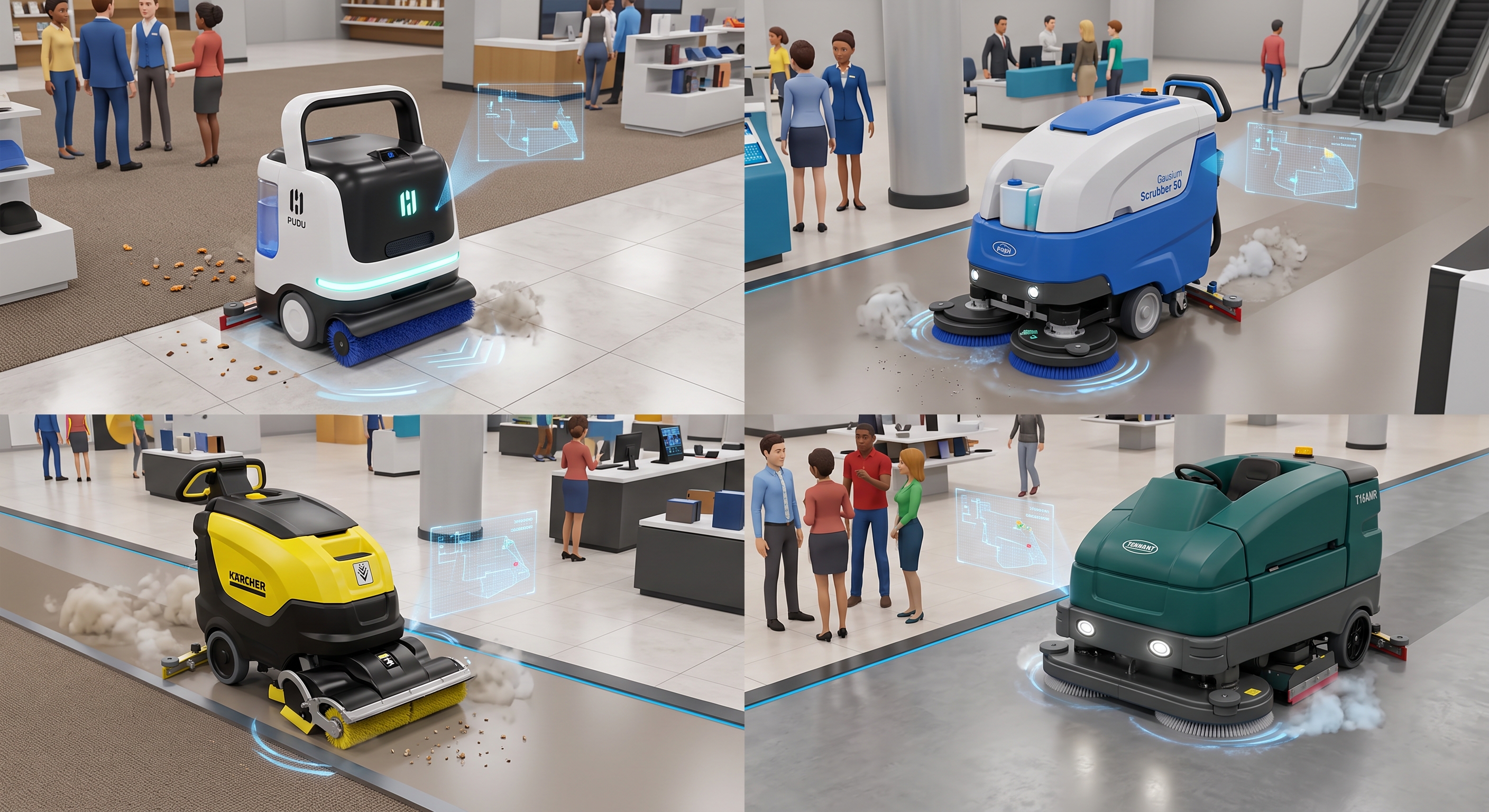
This guide explains how to deploy cleaning robots successfully and compares four popular options: the PUDU CC1, Gausium Scrubber 50, Kärcher KIRA B 50, and Tennant T16AMR.
For many commercial facilities, especially those with mixed flooring and varied daily cleaning needs, the PUDU CC1 is an exceptionally strong place to start.
Floor cleaning is repetitive, physically demanding, and difficult to staff consistently. It also consumes hours that employees could spend on sanitation details, restocking, customer service, inspections, and other tasks requiring human judgment.
An autonomous cleaning robot can take ownership of predictable floor-care routes while the existing team handles higher-value work.
The objective is not simply to replace a manually operated scrubber. A well-deployed robot can also provide:
The business case becomes particularly attractive when large or frequently used floor areas must be cleaned several times per day.
A common automation mistake is selecting hardware before defining the job.
Begin by documenting the current cleaning process:
The answers determine whether the facility needs a compact multifunction robot, a dedicated autonomous scrubber, or a larger industrial machine.
A robot with impressive peak productivity can still be the wrong choice if it cannot fit through a doorway, clean the required floor types, or operate around normal pedestrian traffic.
The PUDU CC1 combines sweeping, scrubbing, vacuuming, and mopping in one autonomous platform. That four-in-one design is its most important advantage.
Many facilities contain a mixture of tile, vinyl, sealed concrete, lobby flooring, and carpet. Instead of purchasing separate machines for different surfaces or assigning the remaining work to employees, the CC1 can cover a much broader portion of the cleaning plan.
According to Pudu Robotics, the CC1 offers:
Carpet vacuuming requires the appropriate optional assembly, and docking equipment is also sold separately. Those details should be included when estimating the complete deployed cost.
The CC1’s versatility makes it particularly attractive for offices, schools, retail stores, hotels, healthcare environments, restaurants, and other multi-surface facilities. It gives operators one platform to learn, maintain, and monitor instead of requiring a different machine for each cleaning mode.
Pudu has also documented a deployment involving approximately 1,300 CC1 units at a major U.S. convenience retailer. According to the manufacturer’s case study, the retailer selected the CC1 after testing multiple solutions, citing tile-scrubbing results, ease of use, operational efficiency, and support coverage.
While every facility should conduct its own trial, that scale of deployment is meaningful. It shows that the CC1 is not merely a promising concept: it is a practical platform that can be standardized across many active locations.
The Gausium Scrubber 50 is a dedicated autonomous floor scrubber aimed at medium-sized commercial spaces.
Published configurations include disc- and roller-brush versions. Gausium lists practical cleaning efficiency of 500-1,300 m² per hour, a 30-liter clean-water tank, a 24-liter wastewater tank, and up to three hours of scrubbing runtime.
Its larger tanks can be advantageous when the primary requirement is continuous hard-floor scrubbing. Optional side brushes on the roller configuration also increase the cleaning path.
The tradeoff is specialization. The Scrubber 50 is a capable scrubbing platform, but a facility that also needs autonomous carpet vacuuming, sweeping, and mopping may require additional equipment. The CC1’s broader cleaning modes can therefore make it easier to standardize automation across mixed-use buildings.
The Kärcher KIRA B 50 is another strong choice for medium and large hard-floor areas. It uses a roller brush, pre-sweeping function, and side brush, with a published 55-centimeter working width and autonomous area performance of up to 2,300 m² per hour.
Kärcher emphasizes its intuitive touchscreen, safety systems, web-based reporting, and optional docking station. With the dock, the machine can recharge, refill clean water, discharge wastewater, and rinse its tank.
The KIRA B 50 is a compelling dedicated scrubber for organizations that prioritize hard-floor performance and established commercial cleaning equipment.
However, facilities with mixed surfaces should evaluate the entire workflow. The KIRA B 50 focuses on scrubber-dryer work, whereas the CC1 combines four cleaning modes in one comparatively flexible platform.
The Tennant T16AMR is an industrial-scale autonomous ride-on scrubber designed for demanding environments.
It has a 36-inch cleaning path, a 50-gallon solution tank, and a 60-gallon recovery tank. Tennant positions it for large industrial facilities where substantial capacity, debris pickup, and long operating periods matter.
This is a different class of machine from the CC1. In a large warehouse or manufacturing plant with broad aisles and extensive hard-floor acreage, the T16AMR’s size and capacity may be exactly what the application requires.
In offices, retail stores, schools, hotels, or tighter multi-purpose facilities, that same size may provide less flexibility. The CC1 is generally the more approachable option where maneuverability, mixed flooring, and multiple cleaning modes outweigh the need for industrial-scale tank capacity.
There is no universal cleaning robot for every building. Large industrial plants may benefit from the capacity of the T16AMR, while a dedicated hard-floor program may favor the KIRA B 50 or Scrubber 50.
The CC1 stands out because it solves a wider range of everyday cleaning problems without becoming excessively specialized.
A facility may need to scrub a lobby, sweep a dining area, mop a corridor, and vacuum carpet on the same day. The CC1 can support all four workflows with one platform.
That versatility can reduce equipment duplication and simplify operator training, fleet management, maintenance planning, and spare-parts inventory.
The CC1’s compact form and extendable steering handle help operators move it into position, create maps, and respond to unusual conditions. For multi-floor deployments, teams can develop separate maps and operating procedures for each service area.
Elevator integration and unattended travel between floors require a site-specific engineering review, but the robot’s size and versatility make it a practical candidate for buildings where several floor types must be serviced.
Visual and laser SLAM allow the CC1 to localize itself and navigate through complex spaces. Breakpoint resume helps it continue an incomplete job after charging, while digital reporting makes performance easier to verify.
With optional docking infrastructure, routine charging and water handling can also be automated. Facilities can begin with supervised operation and add infrastructure as utilization grows.
For organizations operating multiple sites, repeatability matters as much as individual-machine performance.
The published convenience-retail deployment demonstrates the CC1’s potential as a standardized platform across hundreds of locations. A common robot, workflow, reporting method, and training program can make expansion much easier than managing a collection of highly specialized machines.
Map the proposed cleaning area and document:
Measure the space instead of relying only on floor plans. Small physical constraints often determine whether a deployment succeeds.
Before introducing the robot, record current performance for at least one representative operating period.
Useful baseline measurements include:
Without a baseline, it is difficult to calculate return on investment or distinguish true productivity gains from novelty.
Choose an area that is meaningful but manageable. A good pilot zone has repetitive cleaning demand, predictable access, and enough floor area to demonstrate labor savings.
Avoid beginning with the most chaotic part of the facility. Early success builds operator confidence and produces the information needed for later expansion.
For the CC1, a mixed-floor pilot can be especially valuable because it demonstrates whether one robot can consolidate several existing cleaning routines.
Autonomous robots perform best when the underlying workflow is organized.
Remove unnecessary floor clutter, define storage locations, repair problematic thresholds, and establish rules for temporary displays or pallets. Decide where employees should park carts and equipment so routes remain available.
This is the same Lean principle used in industrial automation: optimize the process before automating it.
Create maps during normal site conditions, then test the robot during realistic traffic periods.
Validation should include:
Run several complete cycles before treating the route as production-ready.
Even an autonomous cleaning robot needs clear ownership.
Assign responsibility for:
The robot should become part of the cleaning team’s standard work, not an isolated technology project.
Review performance after 30, 60, and 90 days.
Track completion rate, intervention frequency, actual area cleaned, employee hours redirected, consumable use, and maintenance time. Pay particular attention to exceptions: these often reveal opportunities to improve the map, route, schedule, or surrounding workflow.
Once the pilot is stable, expand to the next area or location using a repeatable deployment checklist.
A practical ROI model should include more than the robot’s purchase price.
Include:
Include:
The strongest automation projects do not depend on optimistic assumptions. They create value by reliably taking over a defined, repetitive workload.
Peak square meters per hour do not tell the entire story. A faster robot may lose its advantage if it cannot access half the facility or requires frequent manual support.
A scrubber-only comparison can overlook carpet, entrance matting, dust collection, and routine mopping. This is where the CC1’s four-in-one design becomes particularly valuable.
A live demonstration reveals route constraints, cleaning quality, and employee interaction that cannot be predicted from a specification sheet.
If no one owns daily checks, consumables, reports, and first-line troubleshooting, utilization will decline regardless of the machine selected.
The best deployments redirect people toward detail cleaning, sanitation, inspections, customer service, and exception handling. Clear communication helps employees understand that the robot is a tool for improving the overall operation.
Commercial cleaning robots can improve consistency, increase cleaning frequency, and free employees from hours of repetitive floor work. Success depends on matching the machine to the real workflow and treating deployment as an operational project rather than a simple equipment purchase.
The Gausium Scrubber 50, Kärcher KIRA B 50, and Tennant T16AMR each offer compelling advantages for particular hard-floor environments.
For facilities seeking the best balance of versatility, approachable deployment, intelligent navigation, digital reporting, and support for mixed flooring, the PUDU CC1 deserves especially serious consideration. Its combination of sweeping, scrubbing, vacuuming, and mopping gives it a broader operational role than many dedicated autonomous scrubbers.
That flexibility can make the CC1 easier to justify, easier to standardize, and more valuable across the full working day.
A successful project should still begin with a site assessment and live pilot. Atan Robotics can help evaluate the workflow, compare equipment, prepare the facility, deploy the system, train the team, and support the automation after launch.
The right cleaning robot is not simply the machine with the largest specification. It is the one that reliably completes the greatest share of your actual cleaning work.
.png)
.png)