

.png)
The evolving demands of modern defense production require unprecedented speed, precision, and supply chain security. Automation and robotics are critical for modernizing the defense industrial base to solve these exact challenges.
They offer the only scalable solution to severe labor shortages, supply chain fragility, and the mandate for zero-defect manufacturing. Transitioning from legacy operations to highly integrated, automated ecosystems is a foundational requirement for national resilience.
The push toward robotic integration is an absolute operational necessity. It is driven by converging structural challenges that make manual, legacy manufacturing a detriment to military readiness.
Decades of offshoring and an increasingly hostile cyber environment have exposed severe vulnerabilities. Manufacturers must address these core challenges immediately to survive in the modern landscape.
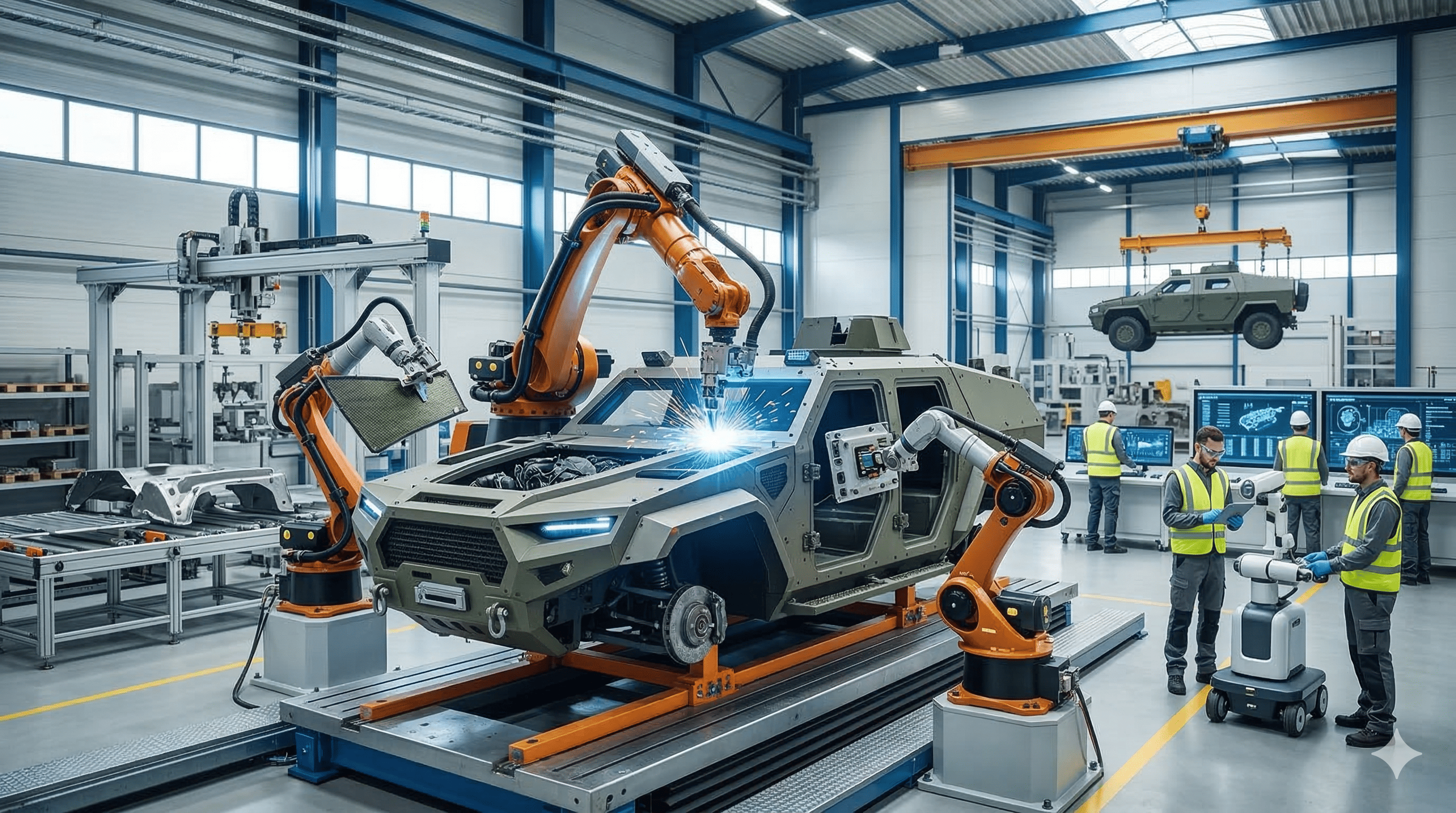
Integrating robotics targets the most labor-intensive and hazardous phases of production. By mapping robotic archetypes to specific processes, the defense industry is systematically eliminating bottlenecks.
Advanced defense components demand metallurgical tolerances that exceed manual physical capabilities. Aerospace turbine blades require lightweight titanium to be machined to complex aerodynamic curves.
Robotic precision machining leverages 6-axis systems to execute these complex geometries reliably. This ensures absolute repeatability across high-volume production runs.
The zero-defect mandate in defense manufacturing requires complete comprehensive verification. Automated Ultrasonic Inspection Systems scan vast surface areas like aircraft fuselages to map structural integrity.
This digital data collection completely eliminates human error. It also generates the immutable audit trails required for compliance reporting.
Tasks involving energetic materials and smart munitions carry extraordinary inherent risks. Automated cryofracture processes allow companies to safely extract and destroy submunitions.
These operations are safely contained behind blast walls far from human operators. This drastic reduction in human exposure is a hallmark of modern defense manufacturing.
The strategic deployment of robotics yields compounded operational benefits. These advantages directly align with the overarching goals of defense modernization.
Automated systems systematically eliminate the physical variations and fatigue inherent in manual labor. For example, robotic welding cells execute thick-plate welds with minimal passes to slash welding times.
Furthermore, modern robotics provide operational agility. This capability allows contractors to adjust to different tactical vehicle variants without highly specific, rigid tooling.
The transition to fully automated defense manufacturing involves significant structural and financial challenges. These barriers must be systematically dismantled to achieve modernization.
Managing high initial capital expenditure is a formidable barrier for small and medium-sized manufacturers. The capital required to re-architect an entire production floor is immense.
However, robots operate continuously without fatigue. Facilities can often increase output by up to 30% without expanding their physical footprint.
The defense industrial base relies heavily on decades-old legacy equipment. These isolated legacy systems were not engineered for broad network connectivity.
Merging ultra-low latency modern robotics with these platforms requires highly customized middleware. They must also be protected via advanced software-defined segmentation.
Securing connected factory floors is a critical matter of national security. As robotic cells connect to the cloud, they expand the operational technology attack surface dramatically.
Manufacturers must implement secure-by-design architectures. This requires robust network segmentation and zero-trust access controls to isolate critical robotic assets.
To navigate the costs and complexities of automation, a lean integration strategy is highly effective. Integrators act as the essential bridge between equipment manufacturers and end-users.
Lean robotics integrators adapt the principles of lean manufacturing to the automation adoption lifecycle. They prioritize speed, minimal overhead, and precise problem-solving.
The intersection of advanced computing and industrial robotics is precipitating a new era of manufacturing. These technological trajectories will define the next generation of defense production.
Generative AI models will provide machines with the cognitive ability to learn and dynamically self-correct. AI-driven robotic cells will analyze real-time data to adjust thermal inputs or cutting speeds instantly.
This eliminates microscopic defects on the fly. It is paramount for the rapid prototyping required by custom defense systems.
A digital twin is a high-fidelity virtual replica of a physical robotic system. Contractors can utilize these software models to test multiple production scenarios before a physical robot is ever deployed.
This virtually eliminates deployment risk and reduces commissioning costs. The continuous data feedback loop also allows for vital predictive maintenance simulations.
The linear assembly line is being challenged by systems where autonomous robots work with a unified consciousness. Coordinated swarms of mobile robots can concurrently assemble massive aerospace structures and install internal components.
Swarm robotics offer unparalleled scalability and absolute precision. They enable manufacturers to construct large assets faster and with lower capital footprints.
The transition from manual to automated defense manufacturing is a critical operational imperative. To offset demographic deficits and achieve zero-defect tolerances, deploying advanced robotics is absolutely non-negotiable.
Embracing lean, agile automation is a strategic necessity to maintain national security. It ensures the defense industrial base retains the manufacturing superiority required to out-produce adversaries globally.

.png)
.png)